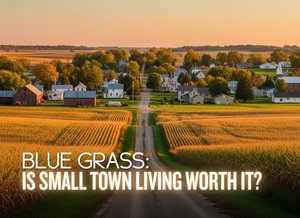
You can live in the Quad Cities without living in one of its larger cities.
That is really the appeal behind living in Blue Grass, Iowa. You are still connected to Davenport and the broader metro, but everyday life happens on a much smaller scale. Fewer commercial corridors. Fewer homes for sale at any one time. Fewer places to run errands without leaving town.
For the right buyer, those are not drawbacks. They are part of the reason to move there. The more useful question is whether you genuinely value that smaller-community setup enough to accept the tradeoffs that come with it.
Small-Town Living Here Actually Means Something
Blue Grass is not a subdivision pretending to be a town. It has its own city government, police, fire department, utilities, public works, and community facilities.
The city maintains five public parks, including Lamphere Park, Lauretta Park, Gless Field Park, Fridley Memorial Park, and Black Bear Park. That gives residents local recreation and community space without requiring every outing to start with a drive into Davenport.
At the same time, Blue Grass simply does not offer the commercial depth of a larger city. Broader shopping, entertainment, healthcare choices, and many everyday services may still pull you toward Davenport or elsewhere in the Quad Cities.
The tradeoff is not “amenities versus no amenities.” It is small-scale convenience versus big-city choice.
Blue Grass Elementary Is Part of a Bigger Community Conversation
Blue Grass Elementary is part of the Davenport Community School District, which surprises some relocating families who assume a smaller city must operate its own separate district. Families should still verify the exact elementary, middle, and high school assignments for any property they are considering.
What makes the school especially interesting is how prominently it appears in Blue Grass's own conversations about growth.
City leaders have discussed attracting additional residential development partly to increase population and student enrollment, describing the elementary school as an important institution the community wants to retain. Those discussions have also included attracting businesses, expanding the tax base, and thinking more deliberately about Blue Grass's long-term direction.
That does not tell a buyer whether the school is right for their child. It does tell you that the school is woven into how local leaders are thinking about the town's future.
A Smaller Housing Market Requires More Patience
Blue Grass is not Davenport with fewer stoplights. A community this size naturally produces a smaller pool of available homes. That can mean fewer choices at any one time and less opportunity to compare six nearly identical properties before making a decision.
As Quad Cities REALTORS®, we have seen why buyers in smaller communities benefit from being prepared before the right listing appears. Financing, budget limits, preferred home style, lot size, and inspection priorities should already be reasonably clear.
It is also why we would not put too much weight on one monthly median or percentage change in Blue Grass. A handful of unusual sales can distort small-market statistics quickly. Property-level comparable sales and active inventory usually tell the more useful story.
Your Commute May Decide Whether Blue Grass Feels Convenient
The value of living here changes dramatically depending on how often you need Davenport. A remote worker who makes a few trips into the city each week may view Blue Grass as comfortably connected.
A household juggling two commutes, school activities, medical appointments, shopping, and evening practices may experience that distance differently. Before buying, test the trips you will actually make:
work.
grocery shopping.
school.
healthcare.
interstate access.
children's activities.
restaurants and entertainment.
Do not judge the commute at 2 p.m. on a quiet afternoon if you will normally be driving it during the morning rush.
Blue Grass Is Thinking About Growth, but It Is Not Trying to Become Davenport Overnight
This may be the most interesting part of Blue Grass's current story.
City discussions have focused on residential development, attracting businesses, improving infrastructure, strengthening the tax base, preserving important community institutions, and adding amenities for current and future residents.
At the same time, officials have acknowledged that land within city limits for residential, commercial, and industrial development is limited. Earlier economic-development discussions also addressed the need for additional housing options while recognizing that the location and type of future development matter to existing residents.
That gives buyers a much more nuanced picture than “Blue Grass is growing.” The city is thinking about its future, but buyers should be comfortable with Blue Grass as it functions today rather than purchasing based on assumptions about what might eventually be built.
Blue Grass or Davenport? Start With What You Are Trying to Escape
The comparison becomes easier when you stop asking which city is “better.”
Blue Grass may fit better if:
small-community living is a real priority;
you do not need extensive shopping or entertainment minutes from home;
access to Davenport still feels practical for your routine;
you are willing to wait for the right home in a smaller inventory pool;
a less urban residential environment matters more than maximum housing choice.
Davenport may fit better if:
you want significantly more homes to choose from;
quick access to shopping, restaurants, healthcare, and activities matters;
you prefer having multiple neighborhood and property-type options;
citywide recreation and amenities are a bigger part of your daily routine.
Neither answer is automatically more sophisticated. They simply reflect different priorities.
Buy Blue Grass for What It Is, Not What You Hope It Becomes
Blue Grass is worth considering when small-town scale itself has value to you.
The appeal is not that it is a cheaper version of Davenport. It is that you can remain connected to the Quad Cities while living in a smaller community with local parks, municipal services, an elementary school that matters deeply to the community, and a city government actively thinking about how much and in what ways it should grow.
The right buyer should like that reality today while treating future housing, business growth, infrastructure, and fiber improvements as possibilities rather than guarantees.
Thinking about moving to Blue Grass, Iowa, or comparing it with Davenport and other Quad Cities communities? Reach out to The BOEYES, Andrea and Brad. We can help you compare available homes, daily commutes, services, property-level details, and the tradeoffs that determine whether small-town living will actually work for your household.
FAQs
Is Blue Grass, Iowa part of the Quad Cities area?
Blue Grass sits west of Davenport and functions as part of the broader Quad Cities region, which allows residents to use Davenport and other nearby communities for employment, shopping, healthcare, recreation, and services.
What parks are in Blue Grass?
The city lists five public parks: Lamphere Park, Lauretta Park, Gless Field Park, Fridley Memorial Park, and Black Bear Park.
Is Blue Grass Elementary part of Davenport schools?
Yes. Blue Grass Elementary is part of the Davenport Community School District. Families should use current district boundary resources to verify all assigned schools for the specific property they are considering.
Is fiber internet available throughout Blue Grass?
Do not assume so. The city has discussed a proposal to study expansion of underground fiber service, but buyers should verify the provider and service currently available at the exact address.
Is Blue Grass planning to grow?
City officials have discussed residential growth, business development, infrastructure, amenities, and increasing the local tax base while also noting limitations on available land. Those discussions should be treated as planning priorities, not guarantees of specific future projects.
About The BOEYES
The BOEYES, Andrea and Brad, guide buyers and sellers throughout Davenport and the Quad Cities with extensive transaction experience and a practical understanding of the local market. In 2025, the team completed 617 transactions and generated $179.99 million in sales volume.
RealTrends ranked The BOEYES as the No. 22 real estate team in the country by transactions and among the top 4% of America’s highest-performing teams. Andrea and Brad have completed more than 1,600 career transactions, giving them experience developed across changing markets, complex negotiations, and a wide range of personal circumstances.
The team has also been recognized among the Top 3 real estate agents in Bettendorf by FastExpert and has received more than 130 five-star reviews across Google and Zillow. Their approach is centered on clear communication, thoughtful preparation, and helping clients understand each stage of the sale without adding unnecessary pressure.